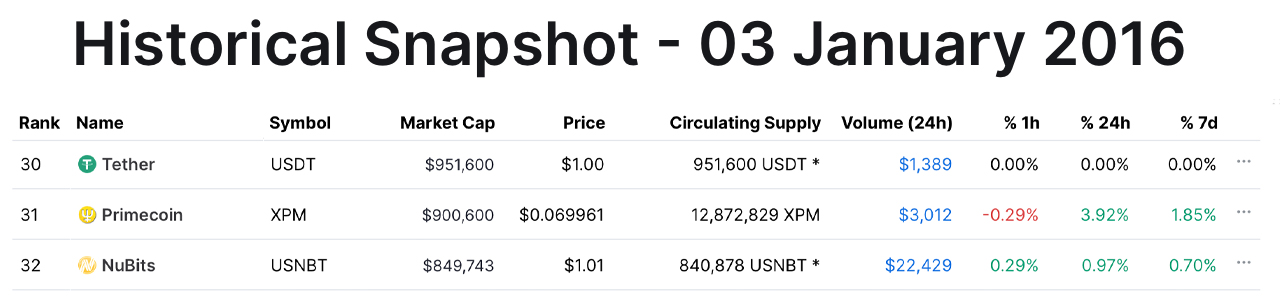
During the last two years since the initial bear market after the 2017 bull run, stablecoins have been extremely popular. Today, statistics show that the market capitalization of all the notable stablecoins today is hovering above the $23.9 billion mark. Out of more than 30 stablecoins in 2020, tether is still a behemoth capturing 76.15% of the entire market share. Since January 2016, the stablecoin tether’s market valuation has grown a whopping 1.9 million percent from $951k to $18.5 billion.
Tether’s Market Cap Jumps from a Million to Over $18 Billion in a Four-Year Time Span
The stablecoin tether (USDT) is by far the most used dollar-pegged token in existence today and the project has grown massively since its inception. At the time of publication, the token USDT was issued 2,236 days ago on October 6, 2014, on the Bitcoin blockchain by leveraging the Omni Layer Protocol.
These days, however, tether is issued on a myriad of blockchains as the stablecoin was first issued on Ethereum using the ERC20 standard. After Ethereum, tether has been minted on Tron, Bitcoin Cash, EOS, Liquid, and Algorand. It has also been announced that USDT will also launch on the Solana Layer 1 blockchain as well.
Tether has been controversial for a number of reasons, but nobody can deny how prominent the stablecoin has been during the last few years. USDT was barely a blip on the radar for the first two years and in 2016, the stablecoin became more noticeable capturing the 30th position in terms of market cap.
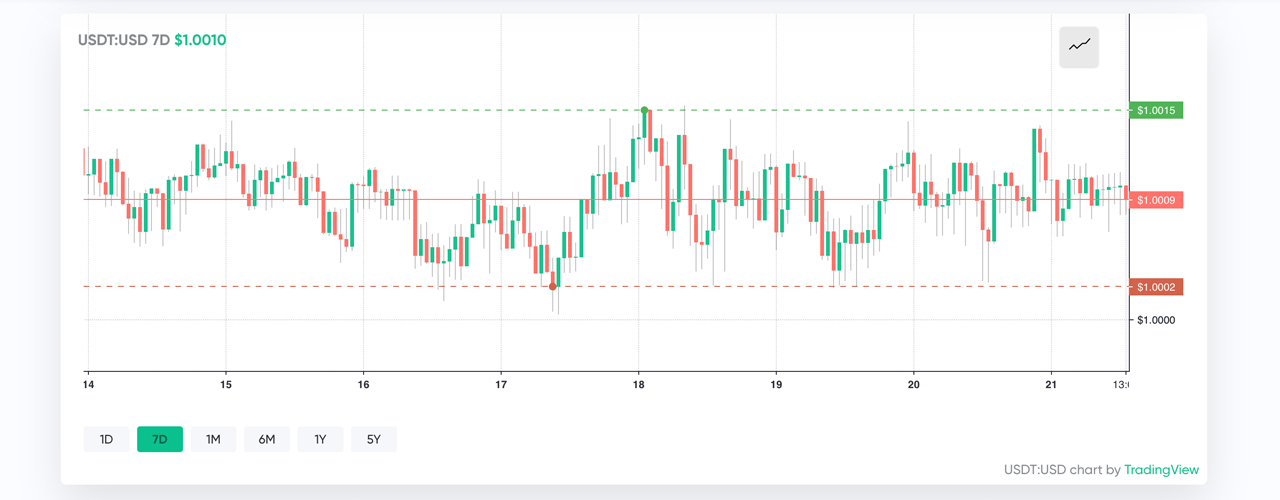
Statistics show that Binance and Huobi Global are the top two exchanges swapping USDT today. The concentration of large tether (USDT) holders is 29% on November 21, 2020, while USDT’s price correlation with BTC is -0.37. During the last seven days, recorded USDT transactions above the $100k region show $16.1 billion has been settled this past week. 45% of USDT transactions stem from the western hemisphere, and 55% come from the eastern side of the world.
Undeniable Growth
On January 3, 2016, the stablecoin tether’s market valuation was a mere $951,600. USDT’s trade volume was only $139,000 in a 24 hour period. At $18.5 billion, USDT in circulation has climbed tremendously by more than 1.9 million percent in just four years.
Tether saw a decent spurt of growth from $951k in 2016 to the very next year’s $9.95 million on January 1, 2017. The stablecoin also managed to squeeze some more positions to achieve the 25th spot in terms of market cap.
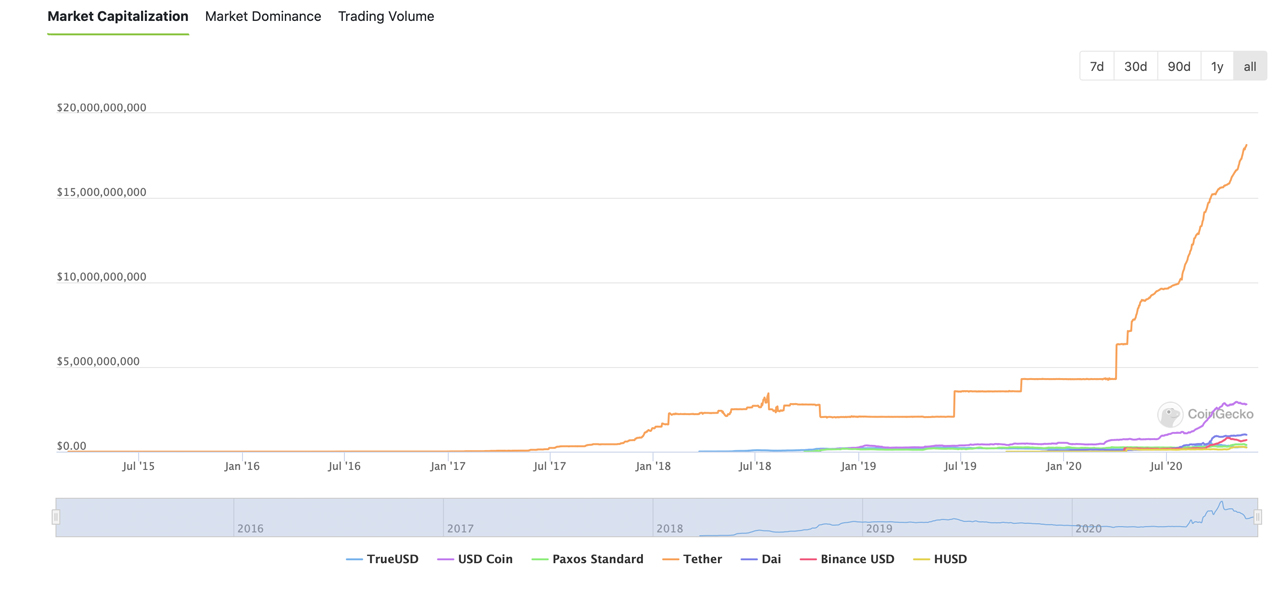
In January 2018, after the 2017 bull market run, tether’s market position dropped to the 37th spot in terms of overall valuation compared to 5,000+ crypto assets. At that time two years ago, 43 crypto assets had a crypto market cap over $1 billion and USDT’s market cap was $1.47 billion.
After another year passed, and on January 6, 2019, tether (USDT) was a top ten crypto asset in the 8th position in January. Coins in circulation only grew from the year prior’s 1.47 billion to 1.91 billion during the first month of 2019.
A year later, tether (USDT) market cap grew over 115% from $1.9 billion to $4.1 billion on January 5, 2020. The stablecoin has seen an enormous expansion since then as the overall valuation expanded by 343% to today’s $18.5 billion.
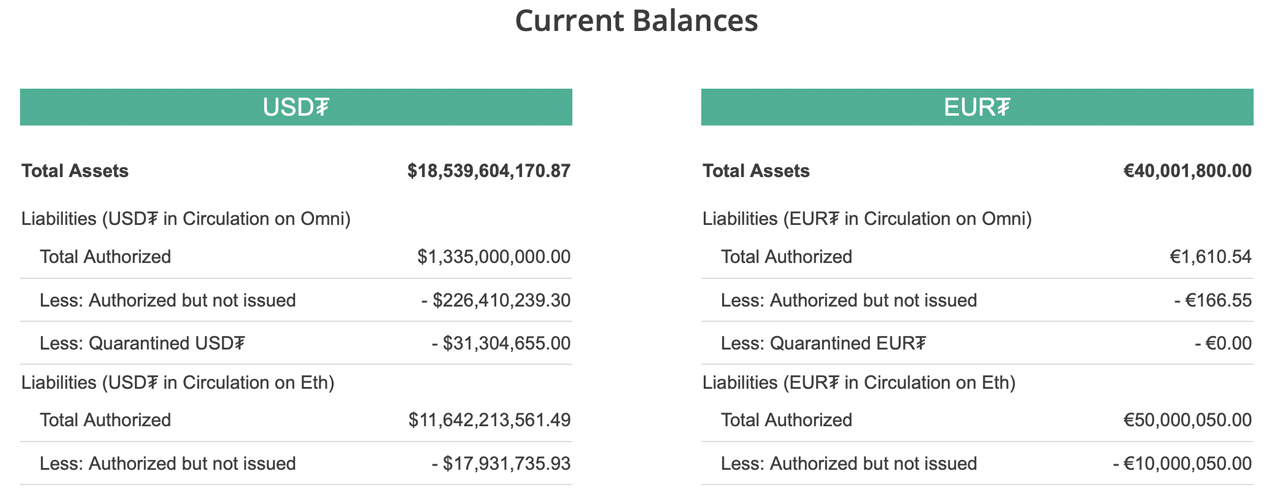
According to USDT’s wallet transparency page, the firm has issued 18,539,604,170 tethers since October 2014. Additionally, there’s 40,001,800 of EURT in circulation and tether gold as well. There are 48,450 tether gold (XAUT) tokens in circulation giving tether gold a $92 million market cap. After the 2017 crypto run-up, tether (USDT) saw competition in the form of rival stablecoins.
Rival Stablecoins and Controversy
Vying stablecoin contenders include USDC ($2.7B), DAI ($1B), BUSD ($679M), and PAX ($399M). Meanwhile, each rival has a different type of dollar-pegging scheme whether it be traditional collateral or overcollateral, like the DAI stablecoin. There are also other fiat currency-pegged tokens tied to international currencies like the euro, yuan, yen, and more. Even though it is quite rare, some stablecoin tokens eventually lost the dollar-peg like the stablecoin nubits (USNBT) and the recent issues with the Origin Protocol’s OUSD.
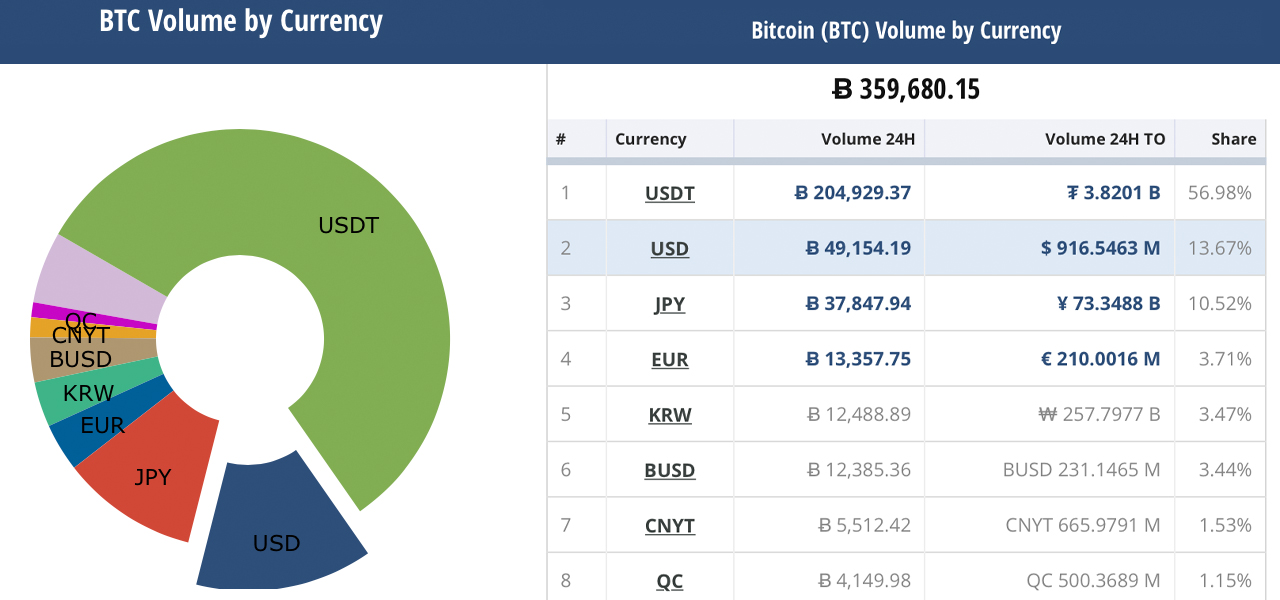
The reason tether is so controversial is because its growth has been inconceivable and the company has also been battling with Attorney General Letitia James’ office. “Our investigation has determined that the operators of the ‘Bitfinex’ trading platform, who also control the ‘tether’ virtual currency, have engaged in a cover-up to hide the apparent loss of $850 million dollars of co-mingled client and corporate funds,” said Attorney General James at the time.
Moreover, the company Tether had told the public that the USDT tokens were backed by U.S. dollars at a 1:1 rate. However, the company subsequently conceded that the tokens were backed by 74% of U.S. dollars and the rest by other forms of collateral.
Tether Operations Limited also responded to the Attorney General’s accusations and categorically denied what the firm considers “false assertions.”
“Bitfinex and Tether have been fully cooperative with the New York Attorney General’s office, as both companies are with all regulators,” Tether said on April 26, 2019. “The New York Attorney General’s office should focus its efforts on trying to aid and support our recovery efforts.” The company added:
Both Bitfinex and Tether are financially strong— full stop. And both Bitfinex and Tether are committed to fighting this gross overreach by the New York Attorney General’s office against companies that are good corporate citizens.
Despite all the controversy from the Attorney General and discord from skeptics, USDT has continued to prosper month after month. Today, the crypto asset is the third-largest blockchain, in terms of market cap, and it doesn’t seem like it’s going away anytime soon.
Commentaires
Enregistrer un commentaire